
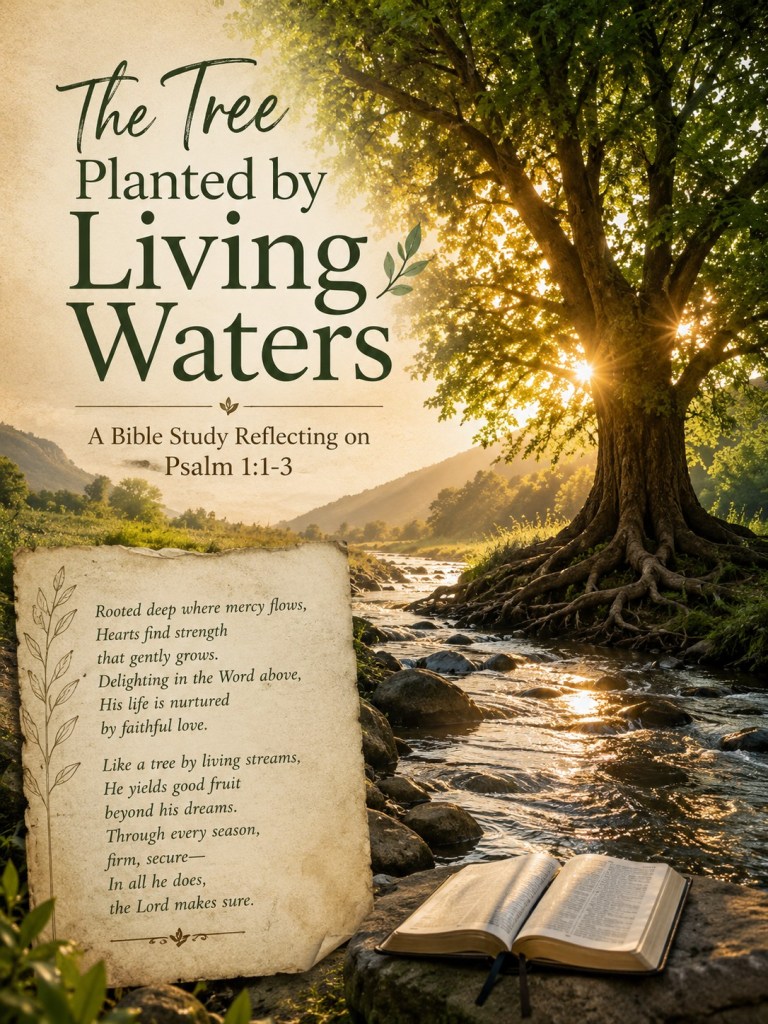
A Bible Study Reflecting on Psalm 1:1-3
Psalm 1 opens the book of Psalms not with noise, triumph, or spectacle, but with a picture of a human life rooted in the right place. Before the Psalms lead into cries of sorrow, songs of worship, prayers for mercy, declarations of hope, and visions of the coming King, they begin by asking a foundational question: What kind of person is truly blessed? The answer given in Psalm 1:1–3 is deeply theological, profoundly practical, and spiritually searching. These verses describe the life that flourishes under the favor of God and the path that leads into enduring spiritual fruitfulness.
The psalm begins with the word “blessed.” This word does not merely refer to temporary happiness, earthly comfort, or circumstantial success. It describes a state of spiritual flourishing under the gracious favor of God. It is the condition of a life aligned with divine truth and ordered according to divine wisdom. The blessed person is not blessed because suffering never comes, nor because every earthly desire is fulfilled. Throughout Scripture, many of the most blessed servants of God walked through hardship, persecution, loneliness, and sorrow. The blessing described here is deeper than outward ease. It is the settled joy of belonging to God and living in harmony with His will.
Psalm 1 immediately frames life as a journey involving paths, influences, and destinations. Human beings are never spiritually motionless. Every person is walking somewhere, listening to someone, becoming something. The psalm therefore begins with a warning about influence and formation. “Blessed is the man who walks not in the counsel of the wicked.” The image is important. Walking implies movement, participation, and direction. Counsel refers not merely to advice but to a worldview, a framework for understanding life. The wicked are those who live without reverence for God and without submission to His truth.
This opening line reveals that spiritual decline often begins subtly. The psalm does not begin with outright rebellion but with listening. Before sinful behavior becomes visible externally, it is often embraced internally through ideas, assumptions, and desires. Human beings are shaped by the voices they trust. The heart absorbs the values of whatever it continually hears. Modern culture constantly offers competing forms of counsel. People are taught to define truth according to personal preference, to pursue self-exaltation above holiness, to seek fulfillment apart from God, and to treat sin lightly. Psalm 1 warns that the blessed life cannot be built upon foundations formed by rebellion against God.
The progression in verse 1 is deliberate and sobering: walking, standing, sitting. First comes walking in the counsel of the wicked, then standing in the path of sinners, and finally sitting in the seat of scoffers. The movement reflects increasing comfort with sin. Walking suggests exposure. Standing suggests identification. Sitting suggests belonging. The person who once merely listened eventually becomes settled among those who mock righteousness and despise truth.
Scoffers represent the hardened stage of spiritual rebellion. They are not merely sinful; they are cynical. They ridicule holiness, dismiss repentance, and mock the things of God. Scripture consistently portrays mockery as a dangerous form of pride because it elevates human judgment above divine authority. The scoffer does not tremble before God’s Word but treats it as foolishness. Psalm 1 therefore shows that sin is not static. Left unchecked, it deepens and hardens the human heart.
This progression remains visible in every generation. A person begins by tolerating ungodly thinking, gradually participates in ungodly living, and eventually becomes hostile toward godliness itself. Spiritual compromise rarely arrives suddenly. It develops through repeated exposure and gradual surrender. The psalm therefore calls believers to spiritual vigilance. The battle for holiness often begins in the realm of influence, imagination, thought, and desire.
Yet Psalm 1 is not merely negative. The blessed life is not defined only by what it avoids but by what it loves. Verse 2 provides the glorious contrast: “But his delight is in the law of the Lord, and on his law he meditates day and night.” Here the center of spiritual life is revealed. The righteous person does not merely reject evil counsel; he treasures divine truth.
The phrase “law of the Lord” refers broadly to the revealed instruction of God. It encompasses God’s Word as the authoritative revelation of His character, will, wisdom, and purposes. The blessed person delights in this revelation. Delight is a word of affection. Scripture is not approached merely as duty, ritual, or intellectual exercise. It becomes the joy of the heart because through it the believer encounters the living God.
This is a profound theological truth. Human beings were created to know God, and therefore the soul finds its deepest nourishment in God’s self-revelation. The Word of God is not cold information; it is divine communication. Through Scripture, God exposes sin, reveals grace, shapes character, strengthens faith, renews the mind, and directs the path of life. The righteous person delights in God’s law because it reveals the God whom the soul was created to love.
Meditation is the natural result of delight. What people treasure, they think about continually. Psalm 1 says the righteous person meditates on God’s law day and night. Biblical meditation differs greatly from many modern ideas of meditation. It is not the emptying of the mind but the filling of the mind with truth. It involves reflection, absorption, remembrance, and careful consideration of God’s Word. It is the steady turning of divine truth over within the heart until it shapes understanding, emotions, desires, and actions.
The phrase “day and night” emphasizes consistency and continual dependence. God’s Word is not treated as an occasional resource but as daily nourishment. Just as the body requires continual sustenance, the soul requires continual truth. A spiritually healthy life cannot survive on occasional moments of exposure to Scripture while spending the majority of life absorbing the values of a fallen world. Psalm 1 calls believers into a rhythm of continual communion with divine truth.
Meditation transforms because the human heart is shaped by what occupies the mind. Thoughts influence desires, desires influence actions, and actions shape character. When the mind dwells continually on God’s truth, the entire direction of life begins to change. Fear is confronted by divine promises. Pride is humbled by divine holiness. Anxiety is steadied by divine sovereignty. Temptation is resisted through divine wisdom. Sorrow is comforted through divine presence. The Word of God becomes living nourishment for the soul.
Verse 3 then presents one of the most beautiful images in all Scripture: “He is like a tree planted by streams of water.” The righteous person is compared to a flourishing tree. This image communicates stability, vitality, endurance, and fruitfulness. Unlike shallow vegetation that withers under heat, this tree survives because its roots reach a continual source of life.
The tree is “planted.” This is important. It suggests intentionality and divine care. The righteous life does not grow by accident. God Himself establishes and sustains His people. Throughout Scripture, God’s people are often pictured as trees, vineyards, or gardens planted by His hand. This image points to covenant relationship and divine cultivation. The believer’s life is rooted not in self-sufficiency but in the sustaining grace of God.
The streams of water symbolize continual spiritual nourishment. In the dry climate of the ancient Near East, water meant survival. A tree beside flowing water could endure seasons that destroyed other vegetation. Spiritually, this image points to the life-giving presence of God communicated through His Word and Spirit. The righteous person draws strength from a source deeper than circumstances.
This truth is critically important. Psalm 1 does not promise that the righteous never face drought externally. Seasons of suffering, grief, opposition, disappointment, and trial still come. Yet the righteous endure because their roots extend beneath the surface into the sustaining life of God Himself. Their spiritual life is not dependent solely upon favorable outward conditions. Hidden communion with God provides inward strength.
The psalm continues by saying the tree “yields its fruit in its season.” Fruitfulness is one of the central themes of biblical spirituality. God desires lives that produce visible evidence of spiritual life. Fruit includes character shaped by the Spirit, obedience flowing from love, righteous actions, compassion toward others, perseverance in faith, worship arising from gratitude, and influence that blesses others.
Fruitfulness, however, occurs “in its season.” This phrase encourages patience and trust. Spiritual growth often unfolds gradually rather than instantly. Trees do not mature overnight. Roots deepen slowly. Fruit develops over time. In the same way, God patiently forms His people through long processes of sanctification. Seasons of waiting are not wasted seasons. Hidden roots are growing even when visible fruit seems delayed.
This image also teaches that spiritual fruitfulness depends upon abiding in the source of life. A tree cannot produce fruit by striving anxiously. Fruit emerges naturally when the tree remains nourished and healthy. Likewise, spiritual fruit grows through communion with God rather than mere external performance. Holiness is not sustained by human willpower alone but through continual dependence upon divine grace.
The psalm further says, “its leaf does not wither.” The image conveys endurance and spiritual resilience. The righteous person is not immune to hardship, but neither are they spiritually destroyed by it. The sustaining life of God preserves them. Even in difficulty, there remains spiritual vitality.
This promise speaks powerfully to a weary generation. Many people live spiritually exhausted lives because they attempt to survive apart from deep rootedness in God. Modern culture often produces restlessness, distraction, emotional instability, and spiritual shallowness. People are constantly connected to noise yet disconnected from spiritual depth. Psalm 1 calls believers back to rootedness. Stability is found not through constant stimulation but through steady communion with God.
Finally, verse 3 declares, “In all that he does, he prospers.” This statement must be understood carefully and theologically. It does not promise that the righteous will always experience worldly success, wealth, or earthly advancement. Scripture repeatedly shows faithful people enduring hardship, persecution, imprisonment, and suffering. The prosperity described here is covenantal and spiritual. It refers to a life aligned with God’s purposes and therefore ultimately flourishing according to divine wisdom.
True prosperity is measured by faithfulness rather than worldly status. A person may possess great wealth and yet remain spiritually barren. Another may suffer materially and yet flourish spiritually in profound communion with God. Psalm 1 teaches that the truly prosperous life is the life rooted in God’s truth and sustained by His presence.
This perspective challenges many modern assumptions. Society often defines success through achievement, influence, possessions, or recognition. Yet Psalm 1 measures life differently. The question is not merely whether a person appears successful outwardly but whether their life is rooted deeply in God. External accomplishments without spiritual rootedness cannot sustain the soul. Only the life nourished by God’s truth possesses lasting stability and eternal significance.
Psalm 1 also serves as an introduction not only to the Psalms but to the broader biblical vision of two ways. Scripture repeatedly presents humanity with two paths: the way of life and the way of destruction, the path of wisdom and the path of folly, the narrow road and the broad road. Psalm 1 introduces this theme by contrasting the righteous and the wicked. One life is rooted and fruitful; the other ultimately perishes like chaff driven by the wind.
This contrast ultimately points toward the necessity of redemption. No fallen human being perfectly embodies the righteousness described in Psalm 1. Every person has listened at times to ungodly counsel and wandered into sinful paths. The psalm therefore creates a longing for the truly righteous man who perfectly delights in the law of the Lord and fully walks in obedience to God.
That righteous man is ultimately revealed in Jesus Christ. He alone perfectly fulfilled the law, resisted temptation without sin, delighted completely in the Father’s will, and remained spiritually fruitful in every season. He is the truly blessed man of Psalm 1. Yet through union with Him, believers are brought into His righteousness and transformed by His life. The flourishing life described in Psalm 1 becomes possible through relationship with Christ.
Jesus Himself echoes the imagery of Psalm 1 in John 15 when He speaks of abiding in the vine. Fruitfulness comes through abiding communion with Him. Separated from Him, humanity remains spiritually barren. Connected to Him, believers receive sustaining spiritual life. Psalm 1 therefore finds its fulfillment not merely in moral effort but in covenant relationship with the living Christ.
Practically, Psalm 1 calls believers to examine the influences shaping their lives. What voices dominate the mind? What patterns of thought are being absorbed daily? What forms of counsel are directing decisions, desires, and priorities? The psalm reminds believers that spiritual formation occurs continuously. Every voice shaping the heart is moving the soul either toward deeper rootedness in God or toward spiritual drift.
The psalm also calls believers to cultivate delight in God’s Word intentionally. Delight often deepens through faithful exposure. As believers meditate on Scripture consistently, the beauty, wisdom, holiness, and grace of God become increasingly precious. Spiritual appetite grows through nourishment. The Word becomes not merely an obligation but a source of life.
Psalm 1 ultimately paints a vision of the human life as it was meant to be: rooted in truth, nourished by God, stable through hardship, fruitful in every season, and flourishing under divine grace. It reminds believers that true life is not found in conformity to a rebellious world but in communion with the living God. The righteous person stands firm not because of personal strength but because hidden roots draw continually from eternal waters.
In an unstable world filled with shifting values, spiritual confusion, and restless striving, Psalm 1 offers a vision of enduring rootedness. The blessed life is not frantic, shallow, or driven by passing trends. It is steady, nourished, fruitful, and anchored in the eternal Word of God. Like a tree planted beside flowing streams, the soul rooted in God possesses a life that endures beyond changing seasons and bears fruit that remains.
 Daily in the Word
Leave a comment