
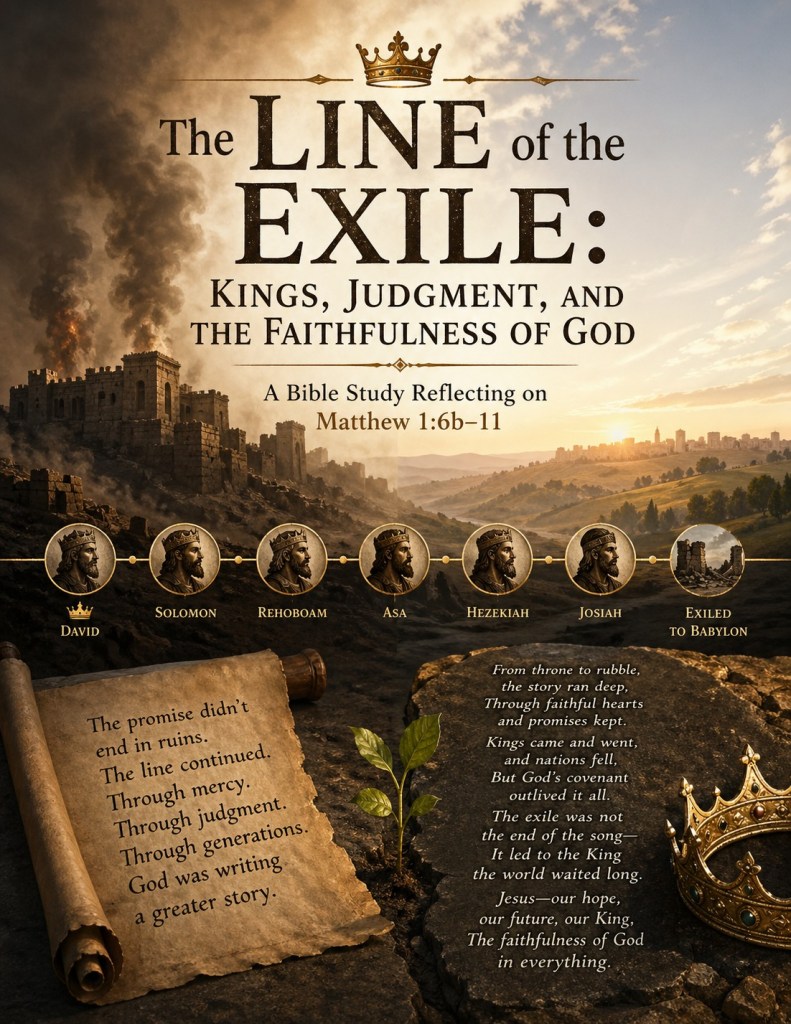
A Bible Study Reflecting on Matthew 1:6b–11
Matthew begins his Gospel with a genealogy that many readers pass over quickly, yet within this list of names lies a profound theological statement. The genealogy is not merely historical information about Jesus’ ancestry; it is a declaration about the faithfulness of God working through centuries of human failure, political upheaval, and divine judgment. In Matthew 1:6b–11 the narrative moves through the royal line of Judah, beginning with David and continuing through the kings until the Babylonian exile. This passage shows that the story of Jesus is inseparable from the story of Israel’s kings, their triumphs and failures, and the devastating judgment that came upon the nation. At the same time, it reveals that God’s purposes continued unbroken even through exile and collapse. Matthew is proclaiming that Jesus emerges from a history marked by sin, judgment, and hope, and that he is the culmination of God’s covenant promises.
The passage begins with David, described as the king. This simple designation carries enormous theological weight. David was not merely one king among many; he was the king through whom God established a covenant that shaped Israel’s future. In 2 Samuel 7, God promised David that his throne would endure and that one of his descendants would reign forever. This promise became central to Israel’s expectation of a coming Messiah, a king who would embody God’s rule and restore the people. By emphasizing David’s kingship at the outset, Matthew signals that the genealogy is about royal succession and covenant fulfillment.
Yet the first detail that follows David introduces complexity rather than triumph. Matthew writes that David fathered Solomon by the wife of Uriah. Instead of naming Bathsheba directly, Matthew identifies her through the man whose death David arranged. The reference deliberately recalls the scandal recorded in 2 Samuel 11. David’s adultery with Bathsheba and the murder of her husband Uriah represent one of the darkest episodes in the life of Israel’s greatest king. By invoking Uriah rather than Bathsheba’s name, Matthew highlights the gravity of David’s sin. The genealogy therefore begins the royal line not with sanitized history but with moral failure.
This choice reveals something crucial about the biblical narrative. God’s redemptive work does not depend on flawless human instruments. The line through which the Messiah comes includes a king whose sin was both personal and political, whose abuse of power brought devastating consequences. Yet God did not abandon his covenant with David. The promise of a future king continued through Solomon, the son born after David’s repentance and restoration. Matthew’s genealogy quietly testifies that divine grace operates even within the aftermath of human wrongdoing.
Solomon’s reign represented the height of Israel’s political strength and prosperity. The kingdom reached its greatest extent, the temple in Jerusalem was built, and Israel’s wisdom traditions flourished. Yet Solomon’s later life also revealed the seeds of decline. His marriages to foreign women led him into idolatry, and the unity of the kingdom began to fracture. After his death, the kingdom divided into two nations: Israel in the north and Judah in the south. Matthew’s genealogy continues through the southern kingdom, the line that preserved David’s throne.
The list of kings that follows traces the story of Judah through generations of leadership. Some of these kings were faithful to God, while others led the nation deeper into idolatry and injustice. The narrative of the Old Testament repeatedly emphasizes that the spiritual health of the nation was closely tied to the character of its kings. When rulers honored the covenant, the nation experienced renewal; when rulers pursued idols and oppression, the nation descended into corruption.
Rehoboam, Solomon’s son, inherited a divided kingdom because of harsh leadership and poor counsel. Abijah and Asa followed, with Asa remembered as a king who sought to remove idols and call the people back to the Lord. Jehoshaphat continued similar reforms, though his alliances with wicked rulers created spiritual compromise. The pattern of mixed faithfulness and failure continued across generations.
Matthew’s genealogy does not narrate these stories in detail, but the names themselves carry the weight of Israel’s history. Each name evokes the narratives recorded in Kings and Chronicles. The genealogy therefore becomes a condensed theological summary of centuries. Readers familiar with the Scriptures would recognize that the royal line was marked by both reform and rebellion, faithfulness and apostasy.
Among the kings mentioned, several stand out as significant figures in Judah’s spiritual life. Hezekiah, for example, led one of the most notable reforms in the nation’s history. He removed idolatrous practices, reopened the temple, and called the people to renewed worship of the Lord. During his reign Jerusalem was miraculously delivered from the Assyrian army, reinforcing the belief that God protected the city where David’s throne stood.
Later came Josiah, another reforming king who rediscovered the Book of the Law in the temple and initiated sweeping reforms. He sought to restore covenant obedience throughout the land. His reign represented a final attempt to return Judah to wholehearted devotion to God before the coming catastrophe.
Yet despite moments of renewal, the trajectory of Judah’s history moved toward judgment. Many kings embraced idolatry, injustice, and spiritual corruption. The prophets warned repeatedly that such behavior would lead to national disaster. Jeremiah, Isaiah, and others proclaimed that covenant unfaithfulness would result in exile.
Matthew’s genealogy brings this history to its climax by mentioning the deportation to Babylon. This event marked one of the most traumatic moments in Israel’s story. In the early sixth century BCE the Babylonian empire conquered Jerusalem, destroyed the temple, and carried many of the people into exile. The Davidic monarchy appeared to collapse completely. The city that symbolized God’s presence lay in ruins, and the royal line seemed powerless.
Theologically, the exile represented divine judgment. The prophets interpreted the destruction of Jerusalem as the consequence of generations of covenant violation. Idolatry, injustice toward the poor, and rejection of God’s commands had finally brought the nation to ruin. The exile was not merely a political defeat but a spiritual crisis.
For many Israelites, the destruction of the Davidic kingdom raised profound questions. If God had promised David an enduring throne, how could the monarchy end in defeat and captivity? Had God abandoned the covenant? Had the promise failed?
Matthew’s genealogy answers these questions in a subtle but powerful way. By tracing the line of David through the exile and beyond, Matthew demonstrates that the covenantal promise did not disappear even when the kingdom collapsed. The royal line continued, though stripped of political power. God’s purposes were not canceled by exile; they were moving toward a greater fulfillment.
This perspective reveals an important biblical theme. God’s promises often continue in hidden or unexpected ways. The exile seemed to signal the end of Israel’s royal hope, yet the genealogy shows that the line of David survived quietly through generations. The promise of a future king remained alive even in the darkest circumstances.
Matthew also emphasizes that the exile itself is part of the story that leads to Jesus. The Messiah does not appear at the peak of Israel’s power but after centuries of struggle and loss. The genealogy therefore presents Jesus as the answer to a long history of disappointment and longing. He is the king who emerges after the failure of every previous king.
Another theological insight emerges from the structure of Matthew’s genealogy. Matthew organizes the genealogy into three sections: from Abraham to David, from David to the exile, and from the exile to Christ. The section we are studying sits in the middle of that structure. It begins with David’s reign and ends with the Babylonian exile, covering the era of the monarchy.
This structure highlights the exile as a turning point in Israel’s story. The monarchy rises with David and falls with the deportation. The second section of the genealogy therefore represents the age of kingship, a period marked by both promise and collapse. By placing the exile at the center of the genealogy’s structure, Matthew emphasizes its significance in the unfolding of God’s plan.
The kings listed in Matthew’s genealogy represent the best and worst of Israel’s leadership. Some pursued justice and worship; others promoted idolatry and oppression. Yet the presence of these flawed leaders in the Messiah’s ancestry communicates a profound message. God works through imperfect human history to accomplish divine purposes.
This truth has significant theological implications. The coming of Jesus does not occur in a sanitized story of moral heroes. Instead, it emerges from a lineage filled with brokenness, compromise, and failure. The genealogy therefore prepares readers to understand the nature of the Messiah’s mission. Jesus enters a world shaped by sin because he comes to redeem it.
The reference to the exile reinforces this redemptive theme. Exile in the Old Testament symbolizes separation from the blessings of God’s presence. The people were removed from the land promised to their ancestors and from the temple that represented God dwelling among them. The return from exile in later generations did not fully restore Israel’s former glory. Many Jews in the first century still viewed themselves as living in a kind of extended exile under foreign domination.
Within this context, the arrival of Jesus signaled hope for restoration. If the Messiah was the heir of David’s throne, then the promises of God were still alive. The genealogy therefore functions as an announcement that God’s covenant story has reached its climax.
Practical application emerges when we consider how Matthew presents history itself. The genealogy shows that God’s purposes unfold across centuries, often through ordinary events and flawed individuals. Human history may appear chaotic or disappointing, but the biblical narrative affirms that God is guiding it toward redemption.
This perspective challenges the assumption that divine activity is visible only in dramatic moments of triumph. Much of the genealogy consists simply of fathers and sons, generations passing quietly without remarkable achievements recorded. Yet each generation carries the promise forward. The cumulative effect of these ordinary lives leads to the birth of the Messiah.
The passage also confronts the reality of moral failure. David’s sin and the corruption of many kings demonstrate that spiritual leaders are capable of serious wrongdoing. Scripture does not hide these failures but records them honestly. At the same time, the genealogy shows that failure does not nullify God’s redemptive purposes. Repentance, grace, and restoration remain possible within God’s covenant relationship.
Furthermore, the exile reminds readers that sin has consequences not only for individuals but for communities and nations. The destruction of Jerusalem was the culmination of persistent injustice and idolatry. The biblical narrative insists that societies cannot ignore moral and spiritual truth indefinitely without experiencing destructive results.
Yet even judgment is not the end of the story. The genealogy continues beyond exile because God’s mercy persists beyond judgment. The same God who disciplines also restores. The continuity of the Davidic line through the exile demonstrates that divine faithfulness outlasts human unfaithfulness.
Matthew’s inclusion of these names therefore functions as a theological proclamation. The Messiah who is about to appear is not disconnected from Israel’s past but deeply rooted in it. Every generation of kings, every reform and failure, every prophetic warning and national crisis contributes to the story that leads to Jesus.
The genealogy invites readers to see history through the lens of covenant. God’s promises to Abraham and David form the foundation of the narrative. Even when circumstances seem to contradict those promises, God remains committed to fulfilling them. The birth of Jesus will reveal the ultimate expression of that commitment.
Matthew 1:6b–11 therefore serves as more than a list of royal ancestors. It is a theological bridge between the Old Testament and the Gospel narrative. The kings of Judah, the tragedy of exile, and the enduring promise of David’s line all point forward to the arrival of a king unlike any before him.
In Jesus, the failures of past kings are answered by perfect obedience. The injustices that corrupted earlier rulers are confronted by a kingdom characterized by righteousness and mercy. The exile that symbolized separation from God is answered by the presence of Emmanuel, God with us.
Thus the genealogy invites readers to view the coming of Christ not as an isolated miracle but as the culmination of centuries of divine faithfulness. Through kings and exiles, victories and defeats, repentance and rebellion, God continued to move history toward redemption. The story that begins with David and passes through the exile ultimately leads to the birth of the one who fulfills the promise of an eternal king and restores the hope of God’s people.
 Daily in the Word
Leave a comment